Caption Idea Best Caption
Most people think about insurance the way they think about their smoke detector — they’re glad it’s there, they assume it’s working, and they don’t examine it closely until something goes wrong. That assumption, applied to smoke detectors, occasionally results in a dead battery and a close call. Applied to insurance, it occasionally results in the complete financial destruction of everything a person has spent a lifetime building.
A policy gap is not a fringe concern for careless or irresponsible people. It is a structural vulnerability that exists in the coverage portfolios of millions of careful, diligent, well-intentioned Americans who simply didn’t know what they didn’t know — who assumed that having insurance and having adequate insurance were the same thing, and who discovered the difference at the worst possible moment.
This guide examines the most financially devastating insurance gaps that routinely exist in ordinary coverage portfolios, what causes them, what they cost when they surface, and what specific actions close them before they become catastrophic. The goal is not anxiety — it’s clarity, because a gap you understand and close costs nothing. A gap you discover after a major loss can cost everything.
The Fundamental Misunderstanding About What Insurance Covers
The single most dangerous belief a policyholder can carry is that their insurance policy covers everything that happens to them. No policy covers everything. Every policy has exclusions — specific events, circumstances, conditions, and loss types that the policy explicitly does not cover. These exclusions are buried in the policy language, written in dense legal prose, and rarely explained at the point of sale. They exist not because insurers are deceptive but because insurance products are designed to cover specific, defined risks at actuarially sustainable prices — and covering everything would make pricing impossible.
The problem is that most policyholders never read their policies. A survey by the Insurance Information Institute found that fewer than one in three homeowners read their policy documents thoroughly. Auto policyholders are even less likely to have engaged with their policy language. Health insurance subscribers are almost universally uncertain about the specifics of their coverage until a claim is denied.
This information gap creates predictable, recurring financial disasters when policyholders discover — after a significant loss — that the event they experienced falls into an exclusion category they didn’t know existed. The discovery that a flooded basement isn’t covered by homeowners insurance, or that a business run from home isn’t covered by a personal policy, or that a teenager’s accident while driving a friend’s car creates personal liability exposure, tends to arrive in the form of a claim denial letter. At that point, the gap has already cost money — sometimes catastrophic amounts of it.
Understanding the most common and most financially devastating gaps before they appear is the only form of prevention that actually works.
The Flood Insurance Gap: The Most Common Catastrophic Exclusion
Flood damage is explicitly excluded from every standard homeowners insurance policy in the United States. Not flood damage in certain circumstances, or flood damage above a certain amount — all flood damage, defined as water that enters a structure from outside rather than from a burst pipe or appliance failure within the structure. A river overflowing its banks, storm surge from a hurricane, heavy rainfall accumulating and entering your home, a neighbor’s blocked drainage system backing water onto your property — all excluded. Completely. Regardless of how much you’ve paid in homeowners premiums over the years.
This exclusion creates the single largest insurance gap in residential coverage, and its consequences are measured in billions of dollars annually. After virtually every major flooding event in the United States, news coverage includes interviews with devastated homeowners who didn’t know their policy excluded flood damage. This happens after every hurricane season. Every major storm. Every river flood event in any region of the country.
The critical point that makes this gap particularly insidious is its geographic scope. The National Flood Insurance Program designates official flood zones, and properties in high-risk zones are required to carry flood insurance as a condition of federally backed mortgages. But approximately 40% of all flood claims come from properties outside designated high-risk flood zones — areas where flood insurance is not required and where homeowners are most likely to assume their standard policy covers the risk because they’ve never been told otherwise.
Climate change has expanded the geographic scope of flood risk substantially. Areas that experienced significant flooding once a generation are now flooding more frequently. Areas previously considered low-risk have experienced flooding events that statistical models didn’t predict. The relationship between official flood zone maps and actual flood risk has deteriorated as weather patterns shift — meaning the official maps understate the current risk profile of many properties that aren’t required to carry flood coverage.
The cost of closing this gap is often far lower than the cost of experiencing it. In moderate-risk areas — outside designated high-risk zones — annual flood insurance premiums through the National Flood Insurance Program often run $400 to $900. Private flood insurance carriers have entered the market in recent years with competitive pricing and sometimes broader coverage than the federal program. On a $350,000 home with $150,000 in contents, a flood loss without insurance coverage can easily exceed $100,000 — a loss that $700 per year in flood insurance would have covered completely.
The conversation that closes this gap takes ten minutes with your insurance agent. The question is simple: “Does my homeowners policy cover flood damage, and what would it cost to add a separate flood insurance policy?” Every homeowner in every geographic location should have this conversation annually, because flood risk exists everywhere — and because the cost of the coverage is dwarfed by the cost of the gap.
The Liability Gap That Can Reach Into Your Future Earnings
Your auto liability coverage has a limit. Your homeowners liability coverage has a limit. These limits — the maximum amount your insurer will pay if you’re found legally responsible for injuring someone or damaging their property — are probably lower than the financial exposure you could actually face in a serious incident, and the gap between your policy limit and your actual liability can attach to your personal assets and future income for years or decades.
Consider the mechanics of a serious auto accident. You cause a collision that seriously injures another driver. Their medical care — emergency transport, surgery, hospitalization, rehabilitation, physical therapy, pain management — generates $280,000 in bills. Their injuries prevent them from returning to their profession for 18 months, representing $95,000 in lost income. Their attorney files a claim for pain and suffering beyond the economic damages. Total claim: $520,000.
Your auto liability coverage limit: $100,000 per person.
Your insurer pays $100,000. You are personally responsible for the remaining $420,000. If you don’t have $420,000 in liquid assets, the plaintiff’s attorney obtains a judgment against you that can be used to garnish your wages, attach to bank accounts, place liens on real property, and follow you financially for years under applicable state law. Your retirement savings may be partially protected depending on your state’s exemption rules. Your home equity may not be.
State minimum liability limits — which many drivers carry because agents quote the legal minimum without strongly advocating for higher coverage — range from $10,000 to $25,000 per person in many states. In 2026, a single emergency room visit can cost $15,000 to $30,000. State minimum liability is not a financial protection — it is a legal threshold that creates the illusion of protection while leaving catastrophic exposure in place.
The solution to this gap is a combination of adequate underlying liability limits and umbrella insurance. Underlying auto and homeowners liability limits should be at minimum 100/300/100 — $100,000 per person, $300,000 per accident for bodily injury, $100,000 for property damage. An umbrella policy — purchased as a separate policy that sits above your auto and homeowners liability limits — adds $1 million, $2 million, or more in additional liability coverage at a cost that is genuinely remarkable for what it provides.
A $1 million umbrella policy typically costs $150 to $350 per year. A $2 million umbrella policy runs $200 to $450 per year. For this annual cost, you add a layer of protection that prevents a single bad day — a moment of distraction while driving, a guest who slips on your stairs, a dog bite that injures a child in your yard — from becoming a financial catastrophe that consumes your savings, your home equity, and years of your future income.
The umbrella conversation is one that financially sophisticated people have with their agents proactively, and that most agents should be initiating themselves. If you have assets worth protecting — a home with equity, retirement savings, investments, income — and you don’t have an umbrella policy, you have the most impactful insurance gap available to close. The premium is modest. The protection is transformative.
The Home-Based Business Gap That Destroys Entrepreneurs
Millions of Americans run businesses from their homes — consulting practices, e-commerce operations, photography studios, tutoring services, childcare facilities, professional services firms, and virtually every other category of small business that doesn’t require a dedicated commercial space. Most of them carry homeowners insurance. Almost none of them know that their homeowners policy explicitly excludes business activity — and that the exclusion can apply to both property damage and liability arising from that business activity.
A graphic designer who stores $8,000 in professional equipment in a home office and files a homeowners claim after a burglary discovers that business equipment is excluded or covered only to a very low sublimit — typically $2,500 at most carriers. The $8,000 in cameras, computers, and professional equipment the policy is expected to cover produces a claim denial or a payment that covers 30% of the actual loss.
A personal trainer who conducts training sessions at home and has a client injured during a session discovers that the homeowners liability coverage excludes business activities — meaning the liability exposure from the injury falls entirely on the business owner personally, without any insurance backstop.
A childcare provider operating from home who has a child injured in their care faces both the liability exposure from the injury and the discovery that their homeowners policy’s liability coverage excludes commercial childcare operations.
These scenarios are not hypothetical — they are documented claim denials that occur regularly because the gap between what homeowners policies cover and what home-based business owners assume they cover is vast and consistently underestimated.
Closing this gap requires specific action based on the nature and scale of the business. For small home-based businesses, a home business endorsement added to the existing homeowners policy may provide adequate additional protection — covering business equipment above the standard sublimit and providing modest business liability coverage. Annual cost: typically $100 to $300.
For larger operations, a business owner’s policy (BOP) — a commercial insurance product that combines property coverage, general liability, and sometimes business interruption coverage in a single package — provides comprehensive protection that personal homeowners policies simply cannot offer. Annual cost varies significantly by business type, revenue, and risk profile, but small home-based businesses often qualify for BOPs at $500 to $1,500 annually.
Professional liability insurance — also called errors and omissions (E&O) insurance — addresses a specific gap relevant to any business that provides professional services or advice. If a client claims that your professional advice, consulting services, or professional work product caused them financial harm, standard homeowners and general liability policies typically don’t cover that claim. Professional liability insurance is specifically designed for this exposure and is essential for consultants, financial advisors, designers, accountants, and any other professional service provider operating from home or otherwise.
The conversation to have: “I run a business from my home. Does my homeowners policy cover the equipment I use for that business, and does it cover liability arising from business activities conducted at my property?” The answer in virtually every case is that the coverage is either absent or severely limited — and knowing that is the beginning of closing the gap rather than discovering it at claim time.
The Auto Insurance Gap When Someone Else Drives Your Car
Auto insurance follows the car, not the driver — a fact that creates predictable coverage gaps when vehicles are lent to friends, family members, or anyone else who isn’t on the policy. If you lend your car to someone and they cause an accident, your auto insurance is the primary coverage for that claim. Your liability limits pay for the damage they caused. Your collision coverage pays for damage to your vehicle, subject to your deductible.
The gap emerges in several specific scenarios that most vehicle owners don’t anticipate.
When a household member drives your vehicle and is not listed on your policy, coverage complications can arise. Most insurers extend coverage to permissive drivers — people you’ve given permission to drive your vehicle — but exclude household members who should have been listed on the policy. An adult child who lives in your home and regularly drives your car but isn’t listed as a driver on your policy is a coverage exclusion waiting to be discovered when they cause an accident. The insurer’s position is that they would have charged you a higher premium to cover this driver, and that failing to list them was a material misrepresentation that voids coverage for incidents involving them.
When a vehicle is used for commercial purposes — rideshare driving, delivery services, or any other income-generating activity — the personal auto policy typically excludes incidents that occur during commercial use. A driver who delivers for a food delivery service and is involved in an accident while making a delivery discovers that their personal auto policy excludes the claim because the vehicle was being used commercially at the time. Rideshare companies provide some coverage during active trips, but the coverage gaps during the period when the app is on but no trip has been accepted represent a genuine exposure that requires a rideshare endorsement or commercial coverage to address.
When you rent a vehicle and decline the rental company’s collision damage waiver — relying on your personal auto policy to cover rental vehicles — the coverage that actually applies depends on the specific language of your personal policy. Some policies extend collision and comprehensive coverage to rental vehicles. Others don’t. Some credit cards provide rental vehicle coverage as a card benefit, but the terms and conditions of that coverage have specific limitations that void it in more circumstances than cardholders typically realize.
Closing these gaps requires specific conversations and specific actions. Household members who regularly drive any vehicle in the household should be listed as drivers on the policy — even if listing them increases the premium. The incremental premium cost is invariably less than the cost of a denied claim. Drivers who use their vehicles for commercial purposes need a commercial auto endorsement or a commercial auto policy that specifically addresses that use. Renters who want to rely on their personal policy for rental vehicle coverage should verify with their insurer specifically whether rental vehicles are covered and under what circumstances.
The Life Insurance Gap That Leaves Families Unprotected
Life insurance coverage gaps are different in character from property and liability gaps — they’re not discovered at claim time in the same way, but when the insured person dies with inadequate coverage, the financial consequences for surviving family members can be as devastating as any property or liability loss.
The most common life insurance gap is simple underinsurance — coverage amounts that made sense when the policy was purchased and haven’t been updated as income, family size, mortgage balance, and financial obligations have grown. A $250,000 term policy purchased when a couple was newly married and childless with a $180,000 mortgage becomes dramatically inadequate a decade later when the family has three children, a $380,000 mortgage, a working spouse who has reduced hours to manage childcare, and a lifestyle that depends on the primary earner’s income.
The standard calculation for adequate life insurance coverage — ten to twelve times annual income, plus the mortgage balance, plus college funding for children — frequently produces a number that is double or triple what most people actually carry. The gap between adequate coverage and actual coverage means that surviving spouses often face a choice between selling the family home, fundamentally changing their lifestyle, and returning to full-time work while managing grief and childcare simultaneously — outcomes that adequate life insurance coverage would have prevented.
Group life insurance through employers — a benefit that many people treat as their primary or only life insurance — creates a specific and common gap: the coverage is tied to employment. When the covered employee leaves the job, is laid off, becomes disabled, or retires, the group coverage terminates. Converting group coverage to individual coverage at that point involves medical underwriting at the employee’s then-current age and health status, which can produce either declination or dramatically higher premiums if health has deteriorated during the years of employer coverage.
The financially rational approach is to treat employer group life insurance as a supplement to individual coverage rather than a replacement for it. Individual term life insurance purchased while young and healthy locks in low premiums regardless of subsequent health changes, remains in force regardless of employment status, and can be sized specifically to the coverage need rather than accepting whatever multiple of salary the employer’s benefit structure provides.
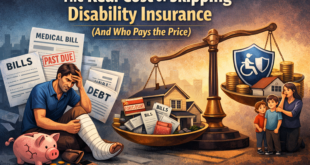
Disability insurance represents a parallel gap that is even more commonly overlooked than life insurance inadequacy. The probability of becoming disabled for 90 days or more during a working career is substantially higher than the probability of premature death — yet most workers carry no individual disability coverage and rely entirely on whatever short-term and long-term disability benefits their employer provides, which frequently replace only 60% of income and are taxable as ordinary income when employer-paid.
A 45-year-old earning $95,000 per year who becomes disabled and can’t work for three years — an injury, a serious illness, a mental health crisis — loses approximately $285,000 in income. The employer’s long-term disability policy, paying 60% of salary at a taxable rate, provides approximately $171,000 in benefits before taxes — leaving a gap of roughly $114,000 in lost income plus whatever additional medical expenses accompany the disability. An individual disability policy covering the remaining 40% of income closes that gap directly. Most people without one are a single serious health event away from financial devastation.
The Renter’s Gap That Millions of People Don’t Know Exists
Approximately 36% of American households rent rather than own, and a substantial majority of those renters carry no renters insurance — operating under the false belief that the landlord’s insurance covers their belongings and their personal liability. It does not. The landlord’s property insurance covers the physical structure — walls, floors, ceilings, building systems — not any of the tenant’s personal property within it, and not any liability the tenant creates.
A renter whose apartment is burglarized loses their laptop, television, jewelry, clothing, and other personal property. The landlord’s insurance pays nothing for the tenant’s belongings. A renter whose kitchen fire spreads to neighboring units faces liability claims from displaced neighbors whose property was damaged and from the landlord for the structural damage caused. The landlord’s insurer will almost certainly pursue a subrogation claim against the tenant who caused the fire, and without renters insurance, that liability exposure falls directly on the tenant personally.
Renters insurance closes both gaps simultaneously — covering personal property against theft, fire, and other covered perils, and providing personal liability coverage that protects against claims arising from incidents in the rented space. The cost is one of the most remarkable values in all of insurance: $15 to $30 per month, or $180 to $360 annually, for $20,000 to $50,000 in personal property coverage and $100,000 to $300,000 in personal liability coverage. For the price of a streaming service subscription, renters eliminate what is otherwise an enormous and completely uninsured exposure.
The additional coverage benefit that renters insurance provides — loss of use coverage, which pays for temporary housing when a covered loss makes the rented unit uninhabitable — addresses a specific vulnerability that renters face acutely. If a fire damages your apartment and you can’t live there for six weeks while repairs are made, loss of use coverage pays for your hotel or temporary rental during that period. Without it, the cost of temporary housing after a covered loss falls entirely on the renter — an unexpected expense that can run $3,000 to $8,000 for even a relatively brief displacement period.
The Health Insurance Gap That Surfaces in a Medical Crisis
Health insurance gaps take many forms, but the one with the most dramatic financial consequences is the network surprise — discovering during or after a medical event that providers you received care from are out-of-network, generating bills at out-of-network rates that produce out-of-pocket costs far beyond what you anticipated.
The specific scenario that has generated the most coverage and the most consumer financial devastation involves in-network hospitals staffed partly by out-of-network providers. You choose an in-network hospital for a procedure. The procedure goes smoothly. Then the bills arrive — not just from the hospital, but from the anesthesiologist, the assistant surgeon, and the pathologist who read your biopsy results. Each of these providers contracts independently with insurers, and one or more of them may not participate in your insurer’s network despite working at a hospital that does. The resulting bills are processed at out-of-network rates, generating cost-sharing that far exceeds what you expected based on your plan’s in-network terms.
The No Surprises Act, enacted in 2022, provides federal protection against certain categories of this surprise billing — specifically protecting patients who receive emergency care at out-of-network facilities and those who receive out-of-network care at in-network facilities without adequate prior notice. However, the protection has implementation gaps and applies differently to self-funded employer plans than to fully insured plans. Understanding the protection you have and the gaps that remain is worth investigating with your HR department or insurer rather than assuming full protection applies.
The out-of-pocket maximum is a protection that many health insurance members don’t fully understand until they’re in the middle of a serious illness. Once you’ve paid your deductible, copays, and coinsurance up to the out-of-pocket maximum, your insurer pays 100% of covered, in-network costs for the remainder of the plan year. The critical limitation: the out-of-pocket maximum applies only to in-network, covered services. Out-of-network costs, costs for non-covered services, and costs for treatments not authorized by the insurer don’t count toward the out-of-pocket maximum and don’t benefit from the 100% payment that kicks in once it’s reached.
A cancer patient who reaches their $8,000 out-of-pocket maximum in March and then receives treatment at an out-of-network specialist whose expertise is specifically required for their cancer type doesn’t benefit from the 100% payment — the out-of-network costs continue to generate 40% or higher coinsurance on top of the in-network maximum they’ve already hit. The financial consequence can reach tens of thousands of dollars in a single plan year.
The Estate Planning Gap That Affects Insurance at Death
Life insurance proceeds, retirement account beneficiary designations, and insurance policy ownership structures create estate planning gaps that can result in insurance benefits being paid to the wrong people, being delayed by probate, being subjected to estate taxes unnecessarily, or being unavailable when needed most.
A beneficiary designation that names a deceased person — a spouse who predeceased the policyholder — means the life insurance proceeds become part of the policyholder’s estate, subject to probate, potentially available to creditors, and distributed according to the will or intestacy rules rather than the policyholder’s current intentions. This scenario occurs more frequently than most people anticipate because beneficiary designations are set once and rarely reviewed despite changes in family circumstances.
A minor child named as a direct beneficiary of a life insurance policy creates a different problem — minor children cannot legally receive insurance proceeds directly in most states. The insurer holds the funds and the court appoints a guardian to manage the money until the child reaches majority. That process involves legal fees, court supervision, and distribution at age 18 rather than at the age the parent might have preferred.
An ex-spouse who remains named as beneficiary on a life insurance policy — because the policyholder updated their will after divorce but forgot to update the beneficiary designation — receives the insurance proceeds regardless of the divorce. Beneficiary designations override the will, the divorce decree, and the policyholder’s clear intentions. Courts have consistently upheld insurance payments to named ex-spouse beneficiaries despite documented evidence that the policyholder intended the proceeds to go to children or a new spouse.
Closing estate planning gaps in insurance requires annual review of every beneficiary designation on every policy, retirement account, and financial account — not just at the time of original purchase or major life events, but systematically every year. The review takes minutes per account and prevents outcomes that no amount of legal maneuvering can correct after death.
The Umbrella Gap for High-Net-Worth Individuals
High-net-worth individuals — those with significant investable assets, real estate, business interests, or income — face a specific liability gap that standard umbrella policies don’t fully address. As assets grow beyond $1 million to $2 million, the liability exposure associated with those assets grows in parallel, and a standard $1 million umbrella policy that was adequate ten years ago may be inadequate for a current net worth of $3 million or $5 million.
Beyond the coverage limit question, high-net-worth individuals face specific liability exposures that standard insurance products don’t address — employer practices liability from household staff, directors and officers liability from nonprofit or corporate board service, professional liability from speaking, writing, or consulting activities, and personal cyber liability from digital assets and online presence. Each of these exposures requires specific coverage that sits outside the standard homeowners, auto, and umbrella framework.
Wealthy individuals who own multiple properties face additional gap risk from properties that aren’t covered by their primary residential coverage — vacation homes with their own liability exposure, rental properties with tenant injury liability, properties under renovation with construction-period risks. Each property requires its own insurance analysis, and the assumption that a primary residence policy extends to other owned properties is one of the more costly assumptions a property owner can make.
Closing the Gaps: A Systematic Approach
The financial stakes of insurance gaps are severe enough to justify a systematic annual review of every policy in your coverage portfolio. This review isn’t complicated — it’s a structured conversation, conducted annually with your insurance agent or independently using your policy documents, that answers a specific set of questions.
Does my homeowners policy cover flood damage? If not, what is my flood risk and what would supplemental coverage cost?
Do my auto and homeowners liability limits, combined with my umbrella policy limit, adequately protect my assets and future income? If I were sued for $2 million today, would my insurance cover it?
Do I run any business activity from my home? Does my homeowners policy cover the related property and liability?
Have I listed every regular driver on my auto policy? Do I use my vehicle for any commercial purposes?
Is my life insurance coverage amount adequate for my current income, family size, mortgage, and financial obligations? Are my beneficiary designations current and correctly structured?
Do I have disability insurance that would adequately replace my income if I couldn’t work for an extended period?
If I rent my home, do I carry renters insurance?
Have I reviewed my health insurance network for all providers I expect to use in the coming year?
Are my estate planning documents — including beneficiary designations on every policy and account — current and correctly structured?
The questions are not technically complex. The answers, for most people, reveal at least one gap worth closing — and frequently reveal several. The cost of closing those gaps, in additional premiums for appropriate coverage, is almost always a fraction of the cost that would result from experiencing the uncovered loss.
Insurance isn’t about anxiety or pessimism. It’s about understanding the specific, concrete risks that standard policy structures leave exposed, and making deliberate decisions about which of those risks to transfer through insurance and which to retain. The gap you close today costs a premium. The gap you discover at claim time costs whatever it costs — and in the scenarios described throughout this guide, what it costs is sometimes everything.
One conversation with a genuinely knowledgeable advisor, one thorough read of your current policy documents, one systematic review of your coverage portfolio — any of these actions can surface a gap that has been quietly waiting to become a catastrophe. The information in this guide gives you the framework to have that conversation productively, to read those documents with the right questions in mind, and to review your coverage with the specificity that transforms passive assumption into active protection.
The gap between what people think their insurance covers and what it actually covers is where financial catastrophe lives. Close the gap before it finds you.